
Crosby Projected and Actual Release Dates
The Texas Department of Criminal Justice defines Projected Release Date as the date its Classification and Records Office calculates for leaving incarceration if parole does not happen first. This field applies to a current TDCJ inmate. It is not the date a Crosby County Jail detainee will make bond, finish processing, or leave on a local order.
| Date or event | What it means |
|---|---|
| Projected Release Date | A TDCJ calculation for leaving incarceration if parole does not occur sooner. |
| Scheduled Release Date | A date shown after certificate and logistics processing has advanced; it can still change. |
| Actual physical release | The accomplished departure recorded by TDCJ or the jail. |
| Parole or mandatory supervision | Physical prison release while the sentence continues under supervision. |
| Discharge Date | The later point when the sentence and its supervision end. |
A parole approval is not physical release. Release certificate preparation, required programs, detainers, placement, or new information may still affect movement. Likewise, discharge must not be used as a synonym for parole. These terms answer distinct questions about confinement and the continuing sentence.
Find a Crosby TDCJ Projected Date
Use TDCJ only after the person has entered the state system. An arrest, conviction, or county-jail sentence in Crosby does not by itself create a TDCJ record.
- Open the TDCJ Inmate Information Search.
- Enter the exact last name with at least a first initial, or use a TDCJ or SID number. Gender and race can narrow a name search.
- Compare identifiers, facility, and offense information before selecting a record.
- Record the offense title, offense date, Projected Release Date, and parole-review information exactly as shown.
- If a Scheduled Release Date and location later appear, record them separately rather than overwriting the projection.
- After the expected event, verify physical release through TDCJ history or Parole Division release processing.
TDCJ states that its web information updates on working days and is at least 24 hours old. The site includes current TDCJ inmates only. A new Crosby transfer may not appear immediately, and a former inmate may disappear after release. Neither situation authorizes a conclusion about present freedom.
The captured TDCJ search form shows both its identifier fields and the current-inmates-only warning.
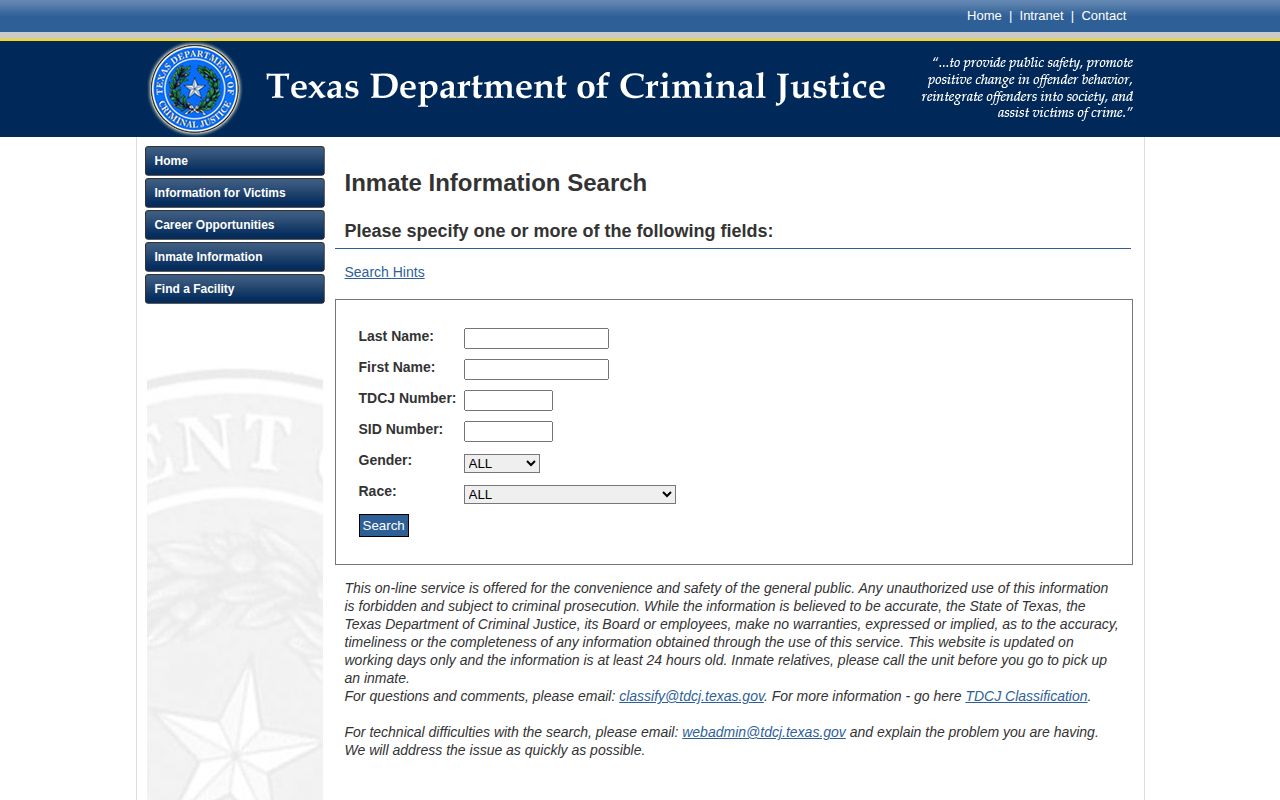
Those limits make the form useful for a current projection but unsuitable as a permanent released-inmate archive.
Crosby County Jail Date Lookup
Crosby County Jail is a local pretrial and short-sentence facility. A pretrial detainee does not have a TDCJ projected date. Release may depend on bond posting, a personal bond, dismissal, acquittal, another court order, or resolution of holds. A sentenced local inmate's date depends on the judgment, jail credit, any applicable local calculation, and the Sheriff's actual release entry.
Call the Crosby County Sheriff at 806-675-7301 and identify the named booking. Ask whether the person remains held, left the community, or transferred, and request the physical release date, time, type, and receiving agency if any. Crosby publishes no official roster, release-date field, 24-hour or 72-hour feed, or online archive.
Local date records
Sheriff / Jail: 806-675-7301, fax 806-675-2804
County Clerk: county criminal orders, 806-675-2334
District Clerk: district and felony judgments, 806-675-2071
Address caution: confirm the jail records delivery address and suite before mailing.
The court file explains the legal basis, while the Sheriff entry confirms the actual exit. A signed order can precede processing, and a TDCJ sentence results in a transfer rather than release to the community.
Texas Good Time for TDCJ Dates
Texas Government Code §498.003 authorizes good-conduct time. Depending on classification and TDCJ rules, it also permits up to 15 additional days for each 30 days actually served for diligent participation in specified work, agricultural, educational, or vocational programs. Good time is not calendar time already served and does not guarantee release.
Credits can affect eligibility calculations, but the offense, offense date, sentence, classification, and release path remain essential. For a mandatory-supervision-eligible offense committed before September 1, 1996, the projection can reflect the point when flat time plus good time equals the sentence if parole has not occurred sooner. For an eligible offense on or after that date, discretionary mandatory supervision also requires Board approval.
A denial can move a projection to maximum expiration or discharge. Later approval can move it earlier. For a mandatory-supervision-ineligible offense, the projected date normally corresponds to maximum expiration on flat time if parole does not intervene. Government Code §§508.147 and 508.149 govern review and exclusions, so a short offense label is not enough for a personal calculation.
No Texas 85-Percent Rule
Texas has no blanket rule requiring every incarcerated person to serve 85 percent. This is the distinctive point most likely to prevent an inaccurate Crosby release-date estimate. Government Code §508.145 contains several offense- and sentence-dependent formulas, and the law on the offense date matters.
For many otherwise covered inmates, subsection (f) reaches parole eligibility when calendar time plus good-conduct time equals one-fourth of the sentence or 15 years, whichever is less. Specified serious cases under subsection (d) generally require actual calendar time without good-time credit equal to one-half of the sentence or 30 calendar years, whichever is less, with at least two calendar years. Other offenses and sentences follow different rules or may be ineligible.
Mandatory-supervision exclusions under §508.149 form a separate analysis. In a post-1996 eligible case, a Board denial can reset the displayed projection to maximum expiration. A later favorable action can alter it again. That is why an old screenshot or hand calculation should not replace the current TDCJ field and official history.
What Changes a Crosby Release Date
A projection is a live administrative calculation based on the information TDCJ has processed. Several inputs can move it, and some affect eligibility without fixing the final departure day.
| Factor | Possible effect |
|---|---|
| Good-time balance | Credits, forfeiture, restoration, and classification can alter eligible calculations. |
| Offense date and law | The governing version of Texas law can change the applicable release route. |
| Sentence information | Corrections, concurrent or consecutive terms, and credit can change the calculation. |
| Mandatory-supervision status | Eligibility, exclusion, denial, or later approval can shift the projection. |
| Parole decision | Approval may allow earlier release, but approval alone is not departure. |
| Program requirement | A program-contingent Board decision can delay processing until completion. |
| Detainer or hold | Another authority may receive the person instead of a community release. |
| Certificate and logistics | Scheduled date and location can change as processing continues. |
Record the source and date each time the field is checked. A change does not necessarily mean an error. It may reflect new sentence data, Board action, credits, or release-processing information.
TDCJ History After the Date Vanishes
Because the public search is current-only, a no-result after an expected date is ambiguous. Use TDCJ's no-charge email information channel. Put the person's name in the subject and send the full name and seven-digit TDCJ number to pia@tdcj.texas.gov. If the number is unknown, give exact date of birth, or approximate age and county of conviction.
Ask separately for incarceration history, any current incarceration, physical release, release type, parole or mandatory-supervision commencement, and final discharge. This wording preserves the difference between leaving prison and finishing the sentence. TDCJ says the email route does not provide photographs or Social Security numbers.
The captured TDCJ information-request page documents the historical fallback and available projected-date information.
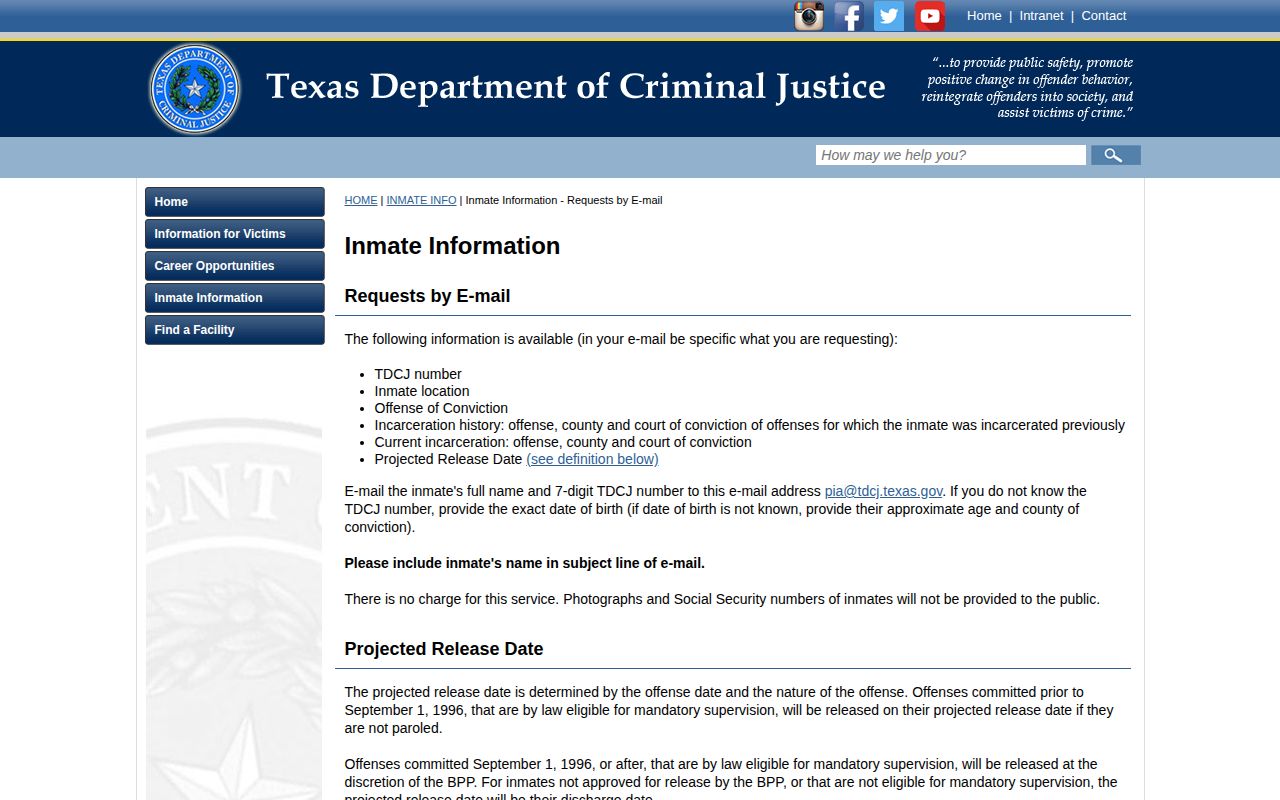
This request route remains useful after the person's current web result no longer appears.
Crosby Release Processing Contacts
TDCJ lists 936-295-6371 and 800-535-0283 for general inmate information during weekday hours from 8 a.m. to 5 p.m. When a TDCJ or SID number is unavailable, exact date of birth is required for telephone identification. Before a Board vote, call 844-512-0461 for review status. After an approval, call 512-406-5202 for release-processing status.
The sequence matters. A review-status answer concerns a Board file. A release-processing answer concerns work after approval. Neither should be restated as accomplished physical release unless the official record confirms it. For a person approved to live in Crosby County, TDCJ maps the county to the Lubbock District Parole Office, but placement determines the actual supervising office.
For a formal history, use the TDCJ Public Information Act form, email PIA@tdcj.texas.gov, or mail TDCJ Public Information Request, PO Box 4017, Huntsville, TX 77342. State the person, identifiers, date range, and precise events sought. The published TDCJ copy framework is not Crosby County's local fee schedule.
Article 17.033 Is Not Good Time
Texas Code of Criminal Procedure Article 17.033 concerns release on bond when probable cause has not been timely determined after a warrantless arrest. It uses 24 hours for a misdemeanor and 48 hours for a felony, with a possible prosecutor-requested postponement up to 72 hours under defined conditions.
Those limits are not sentence good time, a TDCJ projected date, or Crosby County's recent-release window. They should be evaluated from the arrest and court record. A local bond release still requires verification through the Sheriff's physical release entry, especially when another hold or agency transfer may apply.
Confirm the Actual Crosby Release
For a TDCJ inmate, preserve the latest projected and scheduled fields, then check release processing and obtain history after the event. If the result shows parole or mandatory supervision, confirm the supervising office without treating it as final discharge. The VINE Inmate Check explains county IVSS alerts, but TDCJ state-prison victim notification is separate.
For Crosby County Jail, call the Sheriff and request the named booking/release record. Compare it with the County or District Clerk's order or judgment. If the entry names another jail, TDCJ, or another agency, continue with that custodian. A missing portal result, court order, projected date, scheduled date, or parole approval cannot by itself prove unrestricted community release.
Public Record Search
Sponsored Results