
Crosby County Parole Versus Probation
Parole and probation can both place a person under rules in the community, but they begin in different ways. Crosby County parole follows release from Texas Department of Criminal Justice physical custody. The state sentence remains active, and the TDCJ Parole Division supervises the releasee. Mandatory supervision is also a supervised state-prison release path for an eligible person. It is not the same as final discharge.
Crosby County probation, formally called community supervision, comes from a court order. The Lubbock & Crosby County Community Supervision and Corrections Department administers it locally. A judge may order probation instead of prison, after a jail term, or after a later change in the case. Therefore, a probation record does not prove a prior TDCJ release. Likewise, a parole record proves ongoing state supervision, not that the whole sentence has ended.
| Point | Parole or mandatory supervision | Probation |
|---|---|---|
| How it begins | Physical release from TDCJ while a sentence continues | A Crosby County court enters a community-supervision order |
| Primary agency | TDCJ Parole Division and the Texas Board of Pardons and Paroles | Lubbock & Crosby County CSCD and the sentencing court |
| Best verification | TDCJ record, Parole Division, and assigned district parole office | Court order, later docket entries, and local CSCD |
| Final endpoint | Discharge after the sentence and supervision end | Court or CSCD record of completion or discharge |
- Parole
- Conditional release from state prison before the sentence expires.
- Mandatory supervision
- A distinct Texas supervised-release path for an eligible state inmate, subject to the law and Board review.
- Community supervision
- The formal Texas term commonly called probation.
- Discharge
- The end of the sentence or supervision, not merely release from a facility.
Verify Crosby County Post-Release Supervision
Start with the custody path, not an assumption based on a charge or an old booking. An ordinary Crosby County Jail detainee is not automatically a TDCJ inmate. If the person was sent to state prison, the TDCJ offender search can show a current inmate's facility, projected date, and parole review data. That web search is current-inmate only and may lag by a working day. No result is not proof of release or discharge.
For a person believed to be on probation, the sentencing order and later docket entries establish the legal basis. Crosby County criminal cases are split between the County Clerk and District Clerk by case level. The local CSCD may confirm what it can lawfully disclose, but the court record remains the durable source for the order, modification, revocation, or discharge.
- Identify whether the last known custody was Crosby County Jail or TDCJ. Ask for the cause number, TDCJ number, SID, jail ID, or exact date of birth when available.
- For a state-prison case, check the TDCJ record while incarceration is current. Contact Parole Division or the mapped district office to verify active supervision and routing.
- For probation, request the community-supervision order and later entries from the clerk handling the criminal cause. Then contact the Crosby CSCD office.
- Confirm physical release separately. The Sheriff booking/release entry proves departure from county jail, while a TDCJ incarceration history supports a state-prison release.
- Ask whether supervision remains active or has ended in discharge. Do not treat a release date, office assignment, or Board vote as final sentence completion.
Crosby County Supervision Office Split
Crosby County has no single office for every supervised person. TDCJ maps the county to the Lubbock District Parole Office in Region V. That mapping is useful for someone approved to live in Crosby County, but the current office generally follows the approved placement. Conviction in Crosby County does not guarantee that Lubbock still holds the case. Give the person's name plus a TDCJ or SID number, or date of birth, and ask the office to verify or route the inquiry.
Lubbock District Parole Office (DRC)
1720 East Regis Street
Lubbock, TX 79403
Phone: 806-747-8282
Fax: 806-747-8407
The official TDCJ county assignment list documents the Crosby-to-Lubbock parole route.
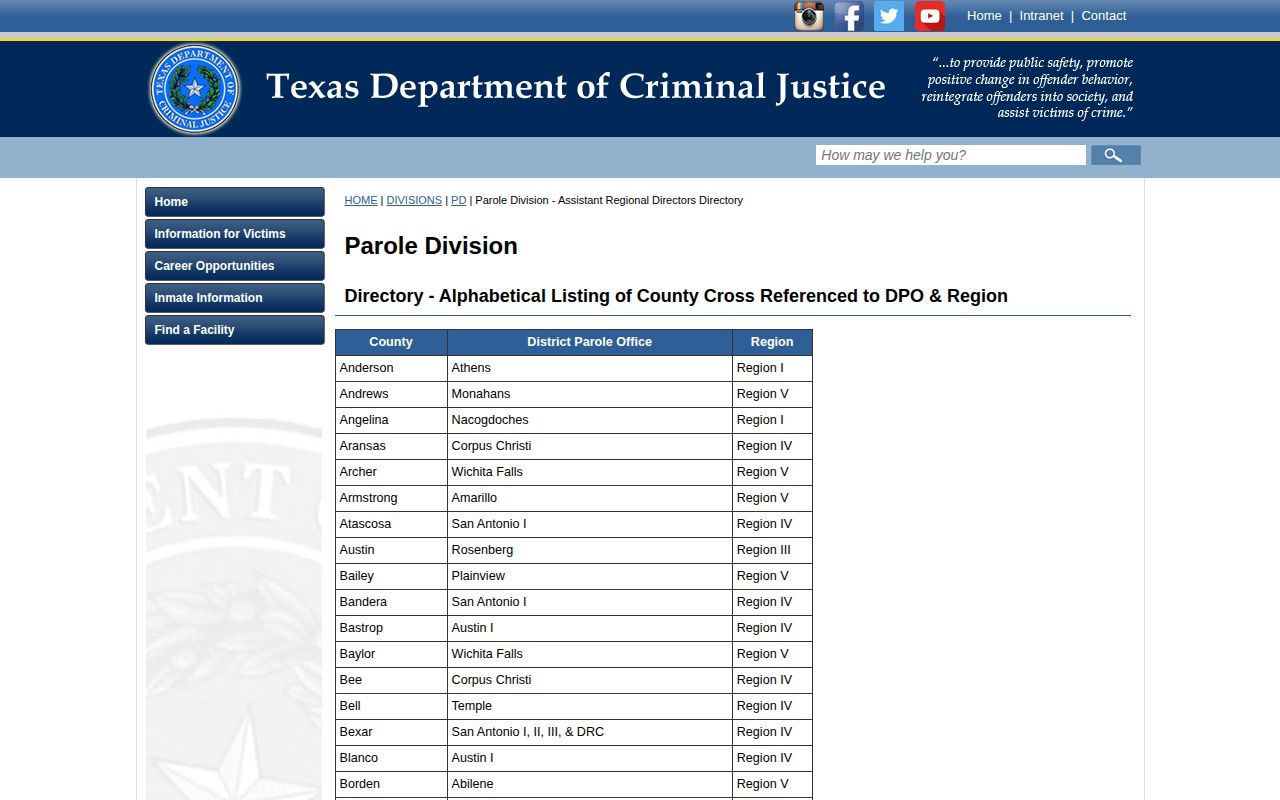
The captured state listing supports the parole contact while leaving room for TDCJ to route a releasee whose approved placement is elsewhere.
Probation stays on a separate local track. The Lubbock & Crosby County CSCD Crosby office is in the courthouse basement. TDCJ's Community Justice Assistance Division sets standards and provides oversight, but it does not work directly with supervised people. Contact the local CSCD and the sentencing court for a Crosby County probation record.
Crosby Probation Office
201 W. Aspen Street, Suite B-100
Crosby County Courthouse basement
Crosbyton, TX 79322
Phone: 806-675-2668
Monday-Friday, 8 a.m.-5 p.m.
Closed noon-1 p.m.
This local split is the clearest way to avoid a false match. Parole questions travel to TDCJ and the assigned DPO. Probation questions travel to CSCD and the court. The Crosby County released-inmate search and records path supplies the separate proof of physical jail release.
Note: Office assignment can follow an approved residence outside Crosby County, so ask the mapped office to confirm the current supervising unit.
Crosby County Supervision Violations
Conditions are the rules attached to parole, mandatory supervision, or probation. Their exact terms come from the release certificate, supervision plan, or court order. Common concepts may include reporting, approved residence, treatment, travel limits, or other case-specific duties, but no condition should be assumed without the actual record. A claimed violation does not, by itself, show that a person is back in Crosby County Jail.
TDCJ defines an absconder as a releasee who stopped reporting and whose whereabouts are unknown. The Parole Division Absconder Tip-Line, 866-680-6667, operates around the clock, but it is a reporting line rather than a directory of all parolees. TDCJ also has a limited public search for absconding sex offenders. A parole warrant gives legal authority to detain. It does not prove that an arrest has occurred.
No official Crosby County Sheriff warrant or absconder list was found. That absence does not mean no warrant exists. Verify state supervision with the parole office, probation status with the CSCD and court, and present custody with the jail that may have made an arrest. Texas IVSS-Counties can provide selected custody and court-event alerts for participating sources, but it is not a complete supervision file.
Crosby County Parole Review Records
Texas does not hold a conventional public formal hearing for each ordinary initial parole or mandatory-supervision review. The Board's review explanation says panel members study and vote files individually. A statewide open Board meeting notice is therefore not a Crosby County case calendar.
The review process generally starts when Parole Division identifies an eligible case. Research identifies an initial review about six months before eligibility and a later review about four months ahead. An Institutional Parole Officer interviews the inmate and prepares a case summary. Three panel members vote in sequence, and two matching votes decide the case.
Decision codes require care. FI-1 means release when eligible, while FI-2 sets a future release point. Program-contingent FI codes require more steps, and RMS concerns mandatory supervision. NR sets another review date. SA generally means serve all, subject to applicable mandatory supervision, and DMS denies mandatory supervision with another review. The official voting-options page defines these codes.
An approval is not physical release. Program completion, release certificates, detainers, new information, or other processing may still intervene, and an approval may be withdrawn. Individual review results can be checked at 844-512-0461 with the name and TDCJ number or date of birth. After approval, 512-406-5202 is the release-processing line.
The state-law framework turns on the offense date and sentence. Texas Government Code Chapter 508 contains multiple eligibility rules and mandatory-supervision exclusions. A charge name alone cannot support a personal release-date calculation.
How Crosby County Supervision Ends
Physical release and discharge are not synonyms. A parolee has left prison but remains under a state sentence. A probationer may live in the community under a court order. Supervision ends only when the authorized agency or court records completion, discharge, expiration, revocation, or another lawful outcome.
For parole, request public incarceration or supervision information from TDCJ when the current-only web search no longer returns a record. The public-information address is pia@tdcj.texas.gov. Give the full name, TDCJ number if known, date of birth, and the event sought. Ask for physical release, supervision commencement, and final discharge as separate fields.
For probation, request the sentencing order and later modification, revocation, or discharge from the clerk responsible for the criminal case. County-level and district or felony matters use different Crosby County clerks. The CSCD can address current administration within lawful limits, while the signed court record explains the legal result.
A sealed, expunged, juvenile, or otherwise confidential record may not be publicly available. Ask the custodian for the legal basis or clarification instead of inferring that a missing record means successful completion. The same caution applies to a current-only search that drops a former inmate after release.
Note: Final discharge is the end of a sentence or supervision; a release from physical custody may occur much earlier.
Public Record Search
Sponsored Results