
Crosby County Booking Photo Records
A mugshot is the identification photograph associated with a booking record. The image can help distinguish one booking episode from another, but its meaning is narrow. It shows that an agency created a photo during processing. It does not establish the final court outcome, whether the person remains in custody, or whether the booking ended in community release or transfer.
Texas Government Code Chapter 552 supplies the Public Information Act request framework. It does not make every booking photograph available in every case. Law-enforcement exceptions, juvenile confidentiality, privacy rules, sealing, expunction, and other laws can control access. Crosby County publishes no blanket photo policy, so availability must be decided for the named booking rather than promised in advance.
The release record is separate. Ask for the booking number, admission date, physical release date and time, release type, and receiving agency when a transfer occurred. A court order or judgment can explain the legal reason, while the Sheriff event record is stronger proof of the physical exit. Pairing those fields with the photograph prevents an old arrest image from being mistaken for current status.
Where Crosby Release Mugshots Appear
No single search covers every Crosby County booking photo. The Sheriff request is the main local archival path. State and notification systems have narrower roles, and an image found elsewhere must be traced back to its source and date.
| Channel | Photo? | Access and limit |
|---|---|---|
| Crosby Sheriff roster or recent releases | No official photo feed found | No online gallery to search; this does not prove the agency lacks a booking image |
| Crosby Sheriff app or social feed | No official channel found | Do not attribute a third-party app or account to the Sheriff |
| Sheriff PIA request | Request the named photo | Best local path; access is case-specific and exceptions may apply |
| TDCJ offender record | May have a state image | State-prison identity image, not the Crosby County booking photograph |
| TDCJ no-charge email | No photo | The email service provides selected inmate data but expressly excludes photographs |
| IVSS-Counties | Do not promise one | Notification and status tool, not an authoritative photo archive |
| Texas sex-offender registry | Photo for covered registrants | Limited registration record, not general release proof |
| Official agency or news release | Sometimes | Keep the source date and context; an arrest report does not prove later release |
| Commercial aggregator category | May mirror images | Discovery lead only; copies may be stale, mismatched, altered, or incomplete |
No Crosby Mugshot App Exists
The official Crosby County Sheriff page publishes no jail roster, recent-release archive, booking-photo gallery, Sheriff mobile app, or official social release stream. Its custody-search direction uses legacy VINELink wording. That documented absence means an app tutorial would be inaccurate.
The official Sheriff contact page and its legacy custody direction show the locally available web route.
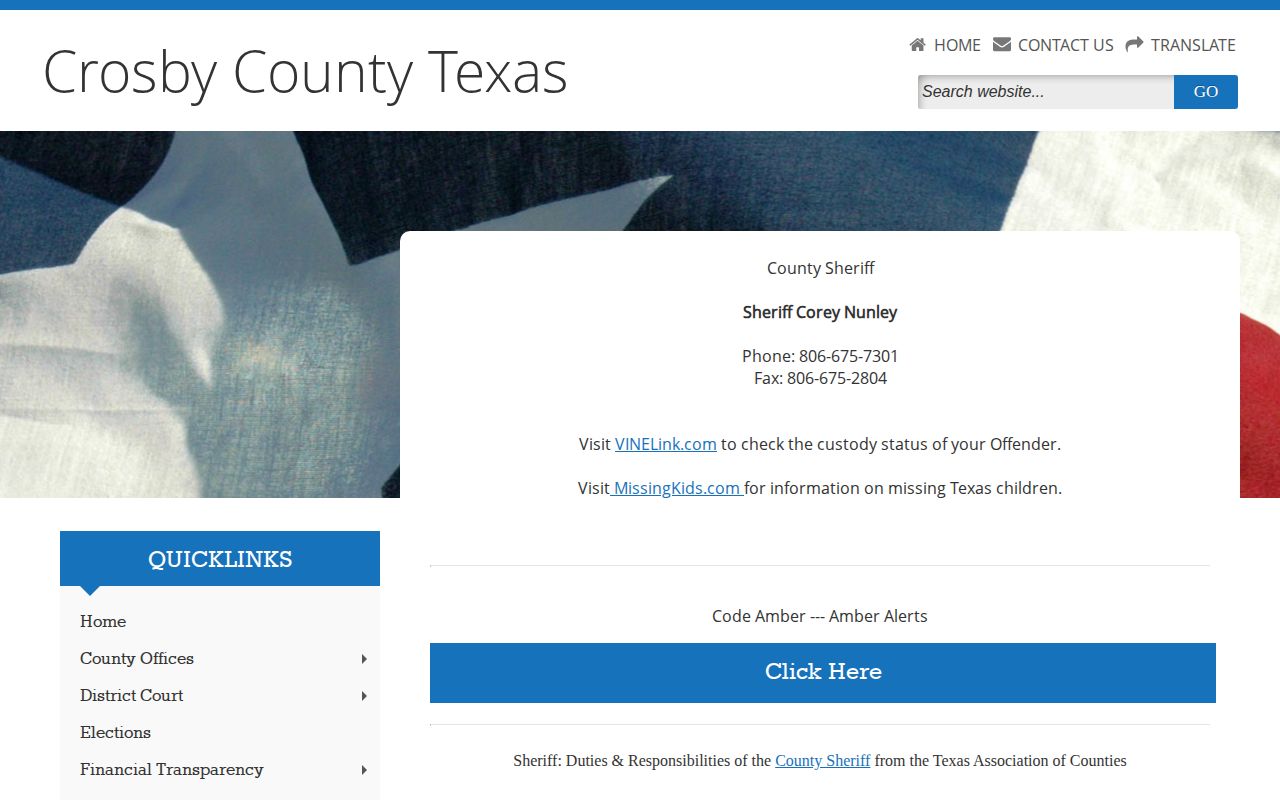
The captured page supports the absence finding and points readers back to a direct Sheriff request for the named booking photograph.
Texas IVSS-Counties can be opened on a phone, but it is a statewide custody and court-notification portal. It is not a Crosby County Sheriff app, and its interface must not be described as a local photo gallery. The service may display data supplied by a participating source, yet it does not promise a photograph or serve as the official booking-image archive.
A commercial app, copied roster, or unofficial social account cannot fill the gap. Such sources may use generic agency details, old images, or unclear dates. Start with the Sheriff and name the booking instead. For recent events, the Crosby County 24-Hour Releases path explains the focused record request used when no county feed exists.
Request Crosby County Booking Photos
Crosby County publishes no dedicated Sheriff records form, portal, email address, local fee schedule, turnaround promise, or categorical booking-photo policy. Begin with the official Sheriff phone at 806-675-7301 or fax at 806-675-2804. Confirm the designated email, mailing address, or hand-delivery route before sending a request. The county page identifies the courthouse, but it does not verify a jail-record suite.
A narrow request works best because the agency must supply existing records rather than create a new report or answer a narrative question. Identify the full name, date of birth or another identifier, approximate booking date, booking number, and cause number when known. Ask for the photograph tied to that one booking episode as an electronic copy. Also request the release or transfer fields needed to establish what happened after the photo was taken.
- Call the Sheriff to confirm the designated written PIA channel and the correct records-delivery address.
- Identify the person and booking with a full name, date of birth or lawful identifier, approximate date, and booking or cause number.
- Ask for the booking photograph associated with that episode and records sufficient to show admission, release date and time, release type, and any receiving agency.
- Request electronic copies. Ask for an itemized estimate before processing if charges will apply.
- Keep the request and proof of receipt. If an image is withheld or redacted, ask the agency to identify the statutory basis.
Government Code §552.234 recognizes written delivery by mail, email, hand delivery, a designated portal, or another approved method. “Promptly” means within a reasonable time without delay, not a universal production deadline of ten business days. If production will take longer than ten business days, the agency generally provides an expected date. Crosby has not published a local flat fee for this request type, so no amount should be assumed.
The Crosby County release-record search gives the broader field-by-field request path. A photo request can be combined with that focused booking inquiry, which makes the image far easier to interpret.
Note: Web disappearance does not show that the official booking photograph or release record was destroyed.
Crosby Mugshots Beyond County Records
A TDCJ offender detail may associate an image with a person admitted to the state prison system. That image is a state corrections identity record, not the photograph from a Crosby County Jail booking. TDCJ's public search also covers current inmates rather than a stable archive of released people. Its no-charge email information service expressly does not provide photographs. A formal state records request is the relevant fallback when a public TDCJ image is specifically needed.
Texas IVSS-Counties serves notifications and status checks for participating county sources. Even if an interface happens to show a source-supplied image, it should not be treated as a permanent photo archive. A former detainee may disappear from search. Preserve any alert, then obtain the Sheriff booking record and named photograph.
The Texas sex-offender registry publishes a color photo for people with a qualifying registration duty. Its scope is limited. A match can help verify the identity and registration status of a covered person, but it is not a list of all released Crosby County inmates and does not establish the release event or final discharge.
Official agency statements and news reports sometimes reproduce an arrest photograph. Preserve the date, agency, and context. An arrest story can remain online long after dismissal, acquittal, transfer, release, or another case result. Commercial criminal-record publishers and mugshot aggregators may also mirror images, but they are only a discovery category. No commercial source is endorsed or linked because stale, altered, mismatched, or incomplete copies cannot replace the government record.
Texas Mugshot Publisher Rules
Texas Business & Commerce Code Chapter 109 regulates certain businesses that publish criminal-record information. Its provisions include correction or removal duties and limits involving fees. It is an anti-exploitation framework for covered commercial publication. It is not a blanket ban on a Texas sheriff providing a booking photograph under the Public Information Act.
That distinction matters in Crosby County because no official photo feed exists. A case-specific Sheriff request asks the government custodian to evaluate one image under the law. A copied commercial page has different risks and duties. If a commercial entry is wrong or legally eligible for correction or removal, use the publisher's statutory process and documented written notice. Do not assume a demand for payment is valid or that payment can alter the official record.
Chapter 109 also does not turn a photograph into proof of guilt or present status. Match it to the exact booking number, then verify the release event and court disposition. A photo without those records is merely an image from an earlier point in the case.
Crosby Mugshots After Expunction
Release from jail does not create automatic expunction eligibility. Texas Code of Criminal Procedure Chapter 55A applies only in defined circumstances, such as qualifying acquittals, pardons, or dismissed and nonfiled cases that meet the legal conditions and waiting periods. A signed order directs covered custodians to destroy, return, or obliterate records as the law provides. That can lawfully change the visibility of a booking photograph.
An order of nondisclosure under Government Code Chapter 411, Subchapter E-1, is different. It generally limits public criminal-history disclosure while preserving access for specified government and criminal-justice entities. Nondisclosure is not the same as destruction, and neither remedy should be inferred from a missing search result.
Use the signed court order to identify the relief and covered custodians. Crosby County criminal cases are divided between the County Clerk for county-level matters and the District Clerk for district or felony matters. A custodian may also withhold juvenile, confidential, sealed, or otherwise protected records. If the photo cannot be produced, request the legal basis instead of assuming that the person was never booked or that every copy must disappear.
Official and commercial copies may not update at the same pace. Send a copy of the controlling order through the source's documented correction route and keep proof of delivery. The order, not the mere fact of release, determines what legal relief applies.
Note: Nondisclosure limits public access in defined ways; expunction can require broader record destruction or return under the signed order.
Public Record Search
Sponsored Results